A visual process to generate
Inquiry Questions
By Dan Curtis-Cummins
Edited version published in “Dynamic Activities for First-Year Composition: 96 Ways to Immerse, Inspire, and Captivate Students” (eds. Reznizki and Coad 2023). Available on Amazon and NCTE Press.
Format: Face-to-face or online synchronous [can be adapted to asynchronous contexts]
Estimated Time: 75 minutes; can be adjusted to 50 min. class
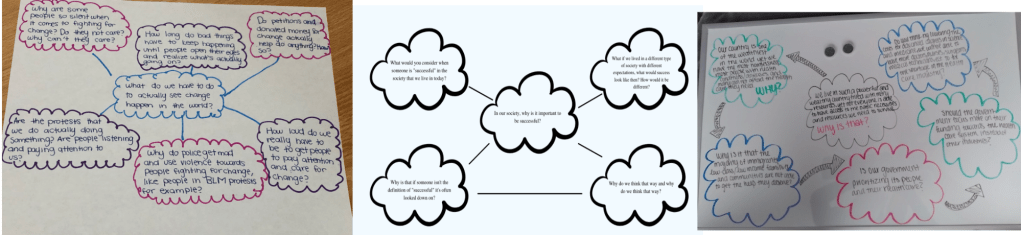
Description: This simple activity is based on students producing a combination of a Mindmap (Buzan; U. of North Carolina Health Sciences Library) and the visual representation of a Word Cloud (Huisman, Miller, and Trinoskey 2011). Through a scaffolded, in-class activity involving multi-modal, visual texts, students create a central question and draw a cloud around it, then expand outward with related subquestions based on the central question. The only rule is that you can only write questions.
The curricular context can be applied to the research process (as I scaffold it in my class), or to reframe any brainstorming activity within both a visual learning and an inquiry mindset that students can apply and transfer to many learning contexts.

Question Cloud Activity Steps
- *Concept-building: In my class, I assigned Alfie Kohn’s “Who’s Asking?” for reading homework to be done before class.
- Schema-build with a check-in related to Alfie Kohn and your “students‘ questions…”
- Overview/Learning Goals: Take 2-3 minutes to introduce the activity; visual learning and inquiry mindset/research goals; and materials required (pen, paper; provide colored pencils of pens if possible/desired)
- Watch/Visual Text: In my class, since Amanda Gorman had just delivered the inaugural poem, we watched Amanda Gorman’s TED Talk (7:19), where she begins with two central questions. I ask students to take notes by focusing on Gorman’s questions, and asking their own questions while listening, in no particular format.
- Discussion/Modeling: On the whiteboard (in-class or virtually), start with Gorman’s central two questions, and ask for students to respond with questions connecting to Gorman’s ideas or diverging with questions related to their own experience.
- Apply/Practice: In-class, students have an opportunity to take their notes from the video and create a Question Cloud of their own, working in groups. Students can get ideas from each other in conversation, can start with Gorman’s questions or their own, and have fun using colors to connect ideas.
- Exit Ticket: Students share their Question Clouds with the class, summarizing their main question and how they expanded outward in their thinking process.
- Scaffolding the larger Project: In my class, students expand and/or use any of the questions in their Question Clouds to choose a research topic, and develop an open-ended Inquiry Question (with sub-questions) for their semester-long research project. Students can also begin a new Question Cloud if their classmates’ brainstorming process sparked interest in a different research topic.
Learning Outcomes (adapted from *WPA Outcomes Statement, 7/18/2019).
Critical Thinking; Develop Curiosity as a Learning Habit
- Develop an inquiry mindset through engagement with a critical text (or video, etc.) and deliberate practice asking open-ended, critical questions relating to the text and students’ own experience and curiosity.
- Use multimodal composing strategies “for inquiry, learning, critical thinking, and communicating in various rhetorical contexts”*
Processes; Develop Visual Invention Processes
- Use visual brainstorming as an intentional invention process; “develop tools [to] discover and reconsider ideas
- “Adapt [visual brainstorming and invention] processes for a variety of technologies and modalities
- “Experience the collaborative and social aspects of writing and research processes
- “Learn to give and to act on productive feedback to works [and research questions] in progress .”*
Impressions:
Based on an Integrated Reading and Writing (IRW) project developed at SFSU called “the Question Paper” (Lockhart, Goen-Salter, Morris, Stedman, among others), this ‘Question Cloud’ activity transforms that written project into an approach that draws on Universal Design for Learning (UDL) principles. Specifically, and importantly when explaining the learning goals to students, this fun process activates students’ visual and multimodal learning styles while introducing them to a new way of approaching all types of brainstorming in college and beyond.
My overall impressions of this activity are resoundingly positive and engaging for students, giving them a chance to practice many important learning outcomes. As stated above, this developed over multiple semesters of adapting the Question Paper assignment, but this semester in our remote learning situation, I decided to redesign the assignment multi-modally. My main purpose in doing this was to integrate the Question Clouds into a larger, semester-long research and writing-heavy project based on other IRW principles and activities, in particular the KWL+ model applied to research. The Question Cloud project fits into the K-W process, where students reflect on what they know about a topic or issue, then based on consciously and deeply exploring their curiosity in the Question Cloud project, create multiple questions to drive their own research process.
Through the peer review process that students’ underwent with their Clouds, as well as student reflection and in-class sharing, I received overwhelmingly positive, enthusiastic feedback. Overall, it was rewarding for me to see students’ work and visual thought processes (examples below). For example, one student wrote in their weekly journal,
“My major takeaways from last week is that deep questions play an important part in literature. They spark conversation, new perspectives, ideas, etc. An interesting concept I learned were the question clouds. It was a good exercise because it got me thinking about how deep my questions can go and looking at other classmates’ clouds made me reflect on their topics….Some feedback I received is that I need to create a separate cloud for one of my questions because it’s a whole other conversation. I do admit it’s a little difficult for me to decide whether a question is relevant or not to my topic, so I’ll be more mindful next time.”
This student shows a development of an inquiry mindset; an invention process where she is beginning to differentiate topics and categories which she can use to structure her paper in her pre-writing process, or even decide if a topic/category is relevant; and displays a sustained commitment to the feedback culture of the class, and how the Question Cloud fit seamlessly into the weekly writing cycles we had established with each other.
Last, I will say that this activity is fun! I encourage students to draw as large as they want, put larger clouds around their favorite or most important questions, and be as colorful as they desire in their drawings, especially if using the colors in purposeful ways (but they don’t have to). Further, this basic, but fun and creative scaffolding approach to writing and research processes enables students to see how they can use different visual brainstorming methods in various learning situations throughout their college careers and lives.
Accommodations:
Any accommodations for hearing or watching the video, as well as writing/drawing the Question Cloud on paper or virtually, should be made with your institution’s Disabilities Resource Center. All students, including those with mild learning differences, really enjoyed this visual brainstorming activity.
Student Models: (permissions available on request)


 Reading and Writing Your World